The HYROX sandbag lunges are the station that separates those who understand race strategy from those who are still guessing.
It's Station 7, coming after 7km of running and six brutal workout stations. Your quads are screaming. You've got 100m of weighted lunges with 20kg (men) or 10kg (women) on your shoulders, followed immediately by 100 wall balls. The instinct? Go conservative. Save the legs for the final run. Survive.
The data from Hyrox Utrecht says that's exactly the wrong strategy.
The Sandbag Paradox: High Variability, Low Impact
Let's start with a surprising finding from our analysis of HYROX Utrecht results.
The sandbag lunges show one of the highest time variabilities of any station. Among athletes finishing between 1:27-1:33 (a tight 6-minute window), sandbag times averaged 5:22 for men and 4:41 for women, but ranged dramatically - some athletes completed it in under 3 minutes, while others took over 9 minutes (extreme outliers excluded from analysis).
When comparing across finish-time brackets (1:20, 1:30, 1:40), the sandbag lunges show 87 seconds of variance for men and 88 seconds for women - significantly higher than SkiErg (22 seconds) or Row (28 seconds). This massive variance means it's a high-leverage training target with serious time-gain opportunity.
But here's where it gets interesting.
The Run 8 Correlation: Attack Without Fear
We analyzed all athletes who finished between 1:27-1:33, examining the relationship between sandbag lunge time and the subsequent Run 8 performance.
The correlation coefficients:
- Men: -0.084 (essentially zero)
- Women: -0.072 (essentially zero)
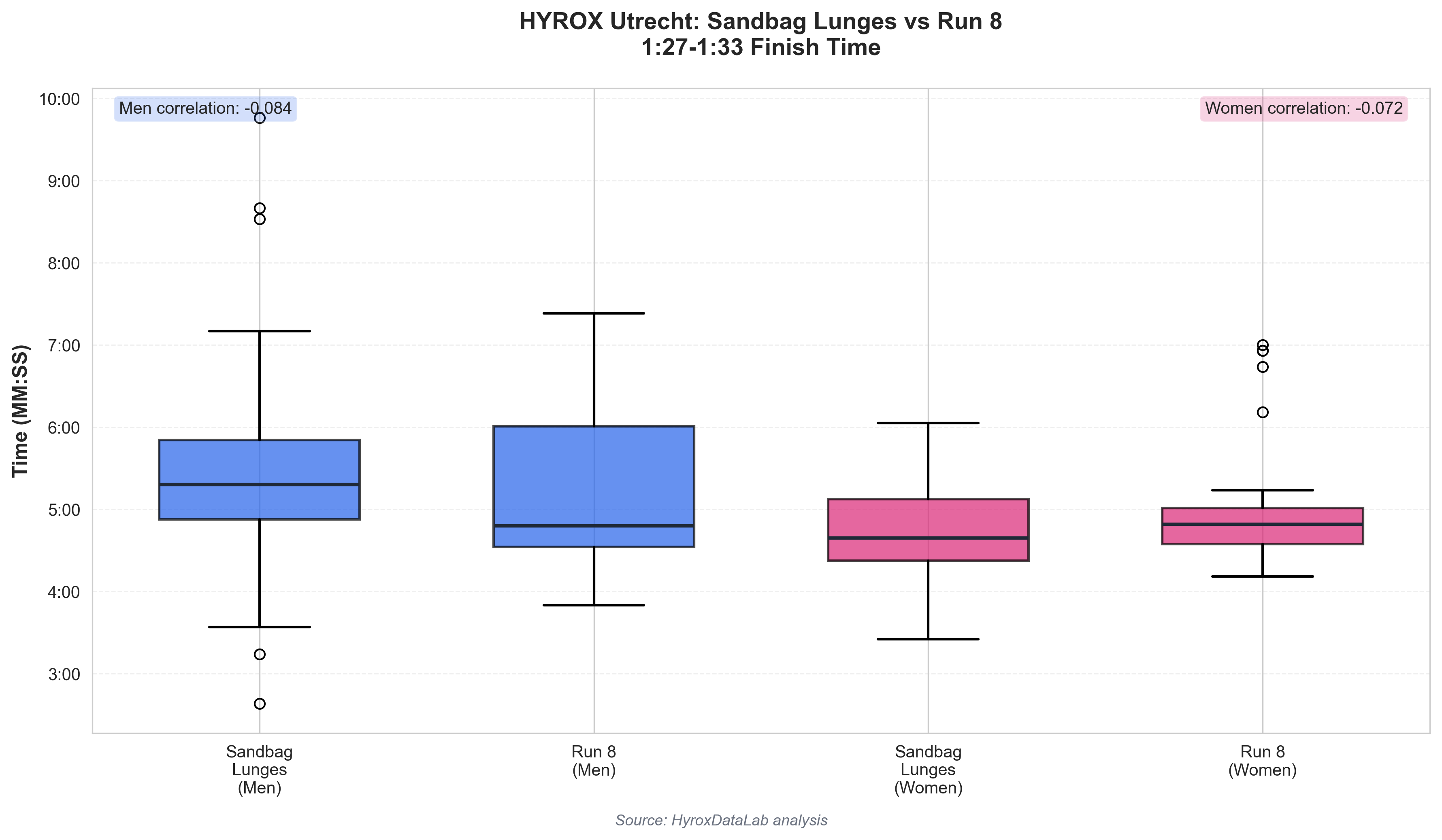
Look at the scatter plots. The trend lines are nearly flat. Athletes who crushed the lunges in 3:30 ran similar Run 8 times as those who took 7:00. The relationship between sandbag speed and running performance is statistically insignificant.
What This Means for Your Race Strategy
Translation: Going hard on the sandbag lunges does not significantly slow your final 1km run.
This destroys the common wisdom of "saving your legs" for Run 8. Athletes who go conservative on lunges thinking they're banking energy for the run are giving away 30-60 seconds for essentially no benefit on the subsequent run segment.
The weak correlation exists for good reason:
- Neuromuscular specificity: Lunge mechanics don't transfer directly to running patterns
- Energy systems: Lunges are primarily anaerobic glycolytic and mechanical fatigue, while running is aerobic with some glycolytic component
- Position in race: When the lunges are over and the last run starts, cumulative fatigue matters more than any single station
The data is clear: attack the sandbag lunges aggressively. The time you lose going slow hurts your finish time directly, while the theoretical fatigue you're avoiding doesn't materially impact your final run.
The Step Length Strategy: Biomechanics Matter
Not all lunges are created equal. Your step length determines three critical variables: total rep count, muscular load distribution, and quad preservation for wall balls.
Step Length Breakdown
| Step Length | Total Steps | Load Distribution | Best For |
|---|---|---|---|
| 0.6-0.7m | ~140-167 | Quad-dominant | Beginners, building endurance |
| 0.8-0.9m | ~111-125 | Balanced | Most athletes - sweet spot |
| 1.0-1.1m | ~91-100 | Glute/hamstring emphasis | Faster athletes with strong posterior chain |
| 1.2m+ | ~83-90 | Very glute-heavy | Elites only |
Key insight: The longer your step, the more you shift load from quads → glutes & hamstrings.
This matters enormously because the very next station after lunges is wall balls - quad hell. Every extra centimeter you can take per lunge saves quad glycogen for the 100+ reps that follow.
The Sweet Spot: 0.9-1.1m Steps
For men (aiming for 1:30 or faster):
- Target: 100-110 total steps
- Step length: 0.9-1.0m
- Expected time: 4:30-5:30
For women (aiming for 1:30 or faster):
- Target: 110-120 total steps
- Step length: 0.85-0.95m
- Expected time: 4:00-5:00
From our analysis:
- Men's median sandbag time: 5:18 (1:27-1:33 bracket)
- Women's median sandbag time: 4:39 (1:27-1:33 bracket)
If you're slower than these targets, step length is your first lever to pull.
The Variance Opportunity: Where Time Separates
Look at average sandbag lunge times across finish-time brackets:
Men:
- 1:20 bracket: 4:07 avg
- 1:30 bracket: 4:50 avg
- 1:40 bracket: 5:34 avg
- Variance: 87 seconds (1:27 difference between elite and recreational)
Women:
- 1:20 bracket: 3:35 avg
- 1:30 bracket: 4:12 avg
- 1:40 bracket: 5:03 avg
- Variance: 88 seconds (1:28 difference)
Context: Only two stations show higher variance than sandbag lunges:
- Wall Balls: 146 seconds variance
- Burpee Broad Jumps: 107 seconds
Compare this to low-variance stations:
- SkiErg: 22 seconds variance
- Row: 28 seconds variance
- Farmers Carry: 26 seconds variance
This means sandbag lunges are a HIGH-LEVERAGE training target. Unlike Row or SkiErg where technique and engine capacity plateau quickly, lunges offer continuous improvement opportunity across all fitness levels. A recreational athlete can gain 60-90 seconds on this station with proper technique and training.
The Wall Ball Connection: Quad Preservation
While sandbag lunges don't correlate with Run 8, they show a strong correlation with wall ball performance: r = 0.738.
This makes biomechanical sense. Both movements demand:
- Quad endurance under load
- Hip flexor strength (getting knee up)
- Core stability
- Mental resilience through leg fatigue
The strategic implication: Your lunge technique directly impacts wall ball capacity. Going quad-dominant on lunges (short steps, upright torso) leaves you with destroyed quads for 100 wall balls. Using longer steps that recruit glutes/hamstrings preserves quad capacity.
Practical example:
- Athlete A: 140 short steps (0.7m) on lunges → quad-dominant loading → wall balls at 7:30
- Athlete B: 100 longer steps (1.0m) on lunges → posterior chain emphasis → wall balls at 6:15
Athlete B saves 75 seconds on wall balls by using superior lunge mechanics, and possibly being faster on the lunges themselves (fewer reps because more ground clearance per rep).
Perfect Sandbag Lunge Technique
Setup
- Sandbag position: High on traps, behind neck (not on shoulders)
- Foot width: 30cm apart laterally (prevents wasting distance while maintaining stability)
- Starting position: Stand tall, core braced
Movement Execution
1. The Step Forward
- Drive knee forward and up (hip flexor engagement)
- Aim for 0.9-1.1m step length
- Land on midfoot, not heel
- Keep torso vertical (prevents forward lean that loads quads more)
2. The Descent
- Drop back knee STRAIGHT DOWN (not angled back)
- Back knee must touch ground (race requirement)
- Front shin should be vertical (knee over ankle, not past toes)
- Keep chest up, eyes forward
3. The Drive
- Push through front foot heel
- Think "stand up and forward" not "push up"
- Glutes drive the movement (posterior chain emphasis)
- Immediately step into next rep
Common Technical Errors
| Error | Consequence | Fix |
|---|---|---|
| Steps too short | 150+ reps, quad overload | Measure 1m, practice hitting that distance |
| Forward lean | Quad dominance, back fatigue | Chest up, eyes on horizon not floor |
| Lateral wandering | Wasted distance, 105-110m actual | Set foot spacing, maintain width |
| Incomplete depth | No-reps, broken rhythm | Back knee MUST touch, every rep |
| Hesitation at bottom | Energy waste, time loss | Touch-and-go, constant movement |
Foot Spacing: Stay Straight, Stay Efficient
Poor line discipline costs time, but not from added distance - it's about balance and stability. If your feet wander laterally in a zigzag pattern, you waste energy stabilizing each step instead of driving forward efficiently.
Athletes who maintain a straight line can stay in a rhythm. Those who drift left and right have to constantly correct their balance, breaking momentum and slowing cadence.
Fix: Mark the course mentally. Pick a line (edge of mat, seam in floor) and stay on it. Maintain consistent foot width (~30cm for men, ~25cm for women) but keep your forward path laser-straight.
Training Protocol: Lunge Mastery in 6 Weeks
Phase 1: Weeks 1-2 (Build Capacity)
Goal: Develop baseline strength-endurance
Workout A - Strength Day:
- Weighted walking lunges: 4 x 50m with 25kg (men) / 15kg (women)
- Bulgarian split squats: 3 x 10 each leg
- Goblet squats: 3 x 15
- Rest: 2-3 min between sets
Workout B - Endurance Day:
- Unloaded walking lunges: 3 x 100m
- Focus: perfect form, 0.9-1.0m steps
- Time target: 5:00-6:00 per set
- Rest: 90 seconds between sets
Frequency: 2x per week (one strength, one endurance)
Phase 2: Weeks 3-4 (Race Specificity)
Goal: Practice race conditions
Workout C - Race Simulation:
- 1km run at race pace
- 100m weighted lunges (20kg/10kg) at target pace
- 50 wall balls
- Rest 3 min, repeat 2-3x
Workout D - Technique Under Fatigue:
- 200 burpees (any pacing)
- Immediately: 100m weighted lunges for time
- Goal: maintain step length when fatigued
Frequency: 2x per week (one simulation, one fatigue test)
Phase 3: Weeks 5-6 (Peak Performance)
Goal: Dial in race pace, perfect technique
Workout E - Time Trials:
- Week 5: 3 x 100m weighted lunges, 2 min rest
- Set 1: 90% effort
- Set 2: 95% effort
- Set 3: 100% effort (race pace test)
- Week 6: 1 x 100m weighted lunges max effort
- Record time, step count, technique notes
Workout F - Station Sequence:
- Farmers carry: 200m (race weight)
- → Immediately: Sandbag lunges 100m
- → Immediately: Wall balls 100 reps
- Full race sequence, no rest between stations
Frequency: Week 5 (2 workouts), Week 6 (1 workout - taper)
Progression Targets
By week 6, you should see:
- Time improvement: 30-60 seconds faster than week 1
- Step count reduction: -10 to -20 steps (longer steps)
- Technique consistency: Able to maintain form under fatigue
- Confidence: Sandbag station no longer feared
Race Day Execution
Pre-Station (During Farmers Carry & Transition)
- Shake out quads during farmers walk
- Mental prep: "Attack this, quads recover during the run"
- Position sandbag high on traps, secure grip
During Station
- First 10 steps: Establish rhythm, find line
- Middle 70 steps: Lock into autopilot, controlled aggression
- Final 20 steps: Push pace, finish strong
- Breathing: Exhale on drive up, inhale at bottom
Post-Station Strategy
- Don't panic about leg fatigue
- RoxZone: Jog slow if necessary, shake legs
- Wall balls: Trust that posterior-chain-dominant lunges preserved quads
- Run 8: Remember - correlation is near zero, legs will respond
The Mental Game: Embrace the Suck
Sandbag lunges are mentally brutal. 100 meters feels like 1000 meters when you're at Station 7. Here's the psychological framework that helps:
Reframe the discomfort:
- "This doesn't affect my run" (data-backed truth)
- "Every second I save here is pure time gain" (high variance = high reward)
- "My competitors are going soft here" (most athletes DO go conservative)
Break it into chunks:
- First 25m: "Just getting started"
- 25-50m: "Rhythm established"
- 50-75m: "Halfway done, halfway home"
- 75-100m: "Sprint finish, smell the wall balls"
Use your surroundings:
- Count down distance markers, not up
- Pick someone ahead to reel in
- Aggressive self-talk ("Let's go!" not "I can do this")
The athletes who win this station aren't necessarily the strongest - they're the ones who refuse to negotiate with discomfort.
Key Takeaways: The New Sandbag Strategy
1. Attack, Don't Conserve
- Correlation with Run 8 is nearly zero (-0.084 men, -0.072 women)
- Going conservative saves no meaningful energy for running
- Time lost going slow = direct impact on finish time
2. Step Length = Everything
- Target: 0.9-1.1m per step (100-110 total reps)
- Longer steps = more glute/hamstring, less quad
- Quad preservation matters for wall balls (r = 0.738 correlation)
3. Technique Under Fatigue
- Practice weighted lunges AFTER metabolic work
- Maintain form when quads are screaming
- Foot spacing discipline (30cm width) prevents distance waste
4. High-Leverage Training Target
- 87-88 seconds of variance across finish brackets
- Only Wall Balls, RoxZone, and Burpees offer more improvement potential
- Most athletes under-train this station = easy competitive advantage
5. Psychological Edge
- Most athletes go conservative here (fear of Run 8)
- Data shows that fear is unfounded
- Aggressive execution = 30-90 seconds gained on field
Additional Data: The Burpee Connection
Interestingly, sandbag lunges also show a strong correlation with Burpee Broad Jumps (r = 0.748) - second only to the wall ball correlation.
This pattern reveals something important: leg endurance capacity predicts performance across multiple late-race stations.
Athletes who excel at lunges typically also excel at:
- Burpee Broad Jumps (explosive leg power + endurance)
- Wall Balls (quad endurance under load)
- Late-race running pace maintenance (Run 6-8)
The underlying trait: anaerobic capacity and muscular endurance in the legs under cumulative fatigue.
Training Implication: Circuit Work
Instead of training lunges in isolation, consider circuits that mirror this correlation:
Leg Endurance Circuit:
- 50 burpee broad jumps
- 100m weighted lunges (20kg/10kg)
- 50 wall balls
- Rest 3 min, repeat 3x
This trains the exact energy system and muscle groups that matter for the Station 5-8 gauntlet.
Race Day Checklist: Station 7 Mastery
Print this. Tape it to your bathroom mirror. Review it race morning.
Pre-Race
- Visualize step length (0.9-1.1m) - know what it feels like
- Review foot spacing cue (30cm width, pick a line)
- Mental frame: "Attack this, zero impact on Run 8"
During Farmers Carry (Station 6)
- Shake out quads during walk (dynamic muscle relaxation)
- Spot the lunge course - identify centerline to follow
- Mental prep: "Next station is my time to gain"
RoxZone (Farmers → Lunges)
- Position sandbag HIGH on traps, NOT low on shoulders
- Secure grip on bag, adjust before starting
- One deep breath, commit to aggression
During Lunges (100m)
- First 3 steps: Establish line, rhythm, and step length
- Steps 4-90: Lock into autopilot, trust technique
- Final 10 steps: Push pace, smell wall balls
- Constant movement - touch and go on back knee
Post-Lunges RoxZone
- Don't panic about leg fatigue (it's normal, won't affect run)
- Walk purposefully to wall balls
- Remind yourself: quads preserved by posterior-chain emphasis
- Wall balls first 20 reps will feel hard - push through
Frequently Asked Questions
Should I break up the sandbag lunges with rest periods?
No. Continuous movement is faster. Every time you stop, you lose momentum and have to re-accelerate the sandbag. Elite athletes go unbroken. Recreational athletes should too - the station is only 100m, not 1km.
How do I train sandbag lunges if my gym doesn't have 100m space?
Do 4 x 25m segments with a 180° turn at each end. Turning adds difficulty (balance challenge), so if you can hit time targets with turns, you'll be faster on the straight race course.
What if I'm too fatigued to take 1m steps during the race?
This indicates either: (1) you've over-paced early stations, (2) insufficient leg endurance base, or (3) poor nutrition strategy (glycogen depleted). Fix the root cause - don't adjust lunge strategy to compensate for earlier mistakes.
Should I use a weight vest or sandbag for training?
Sandbag on shoulders, always. Weight vest doesn't replicate the specific stability challenge and load position of race conditions. Train specific to race requirements.
Are these step length targets realistic for shorter athletes?
Yes, with proper hip mobility. Step length isn't purely a function of height - it's hip flexor range + glute strength. Shorter athletes may need slightly shorter steps (0.85-0.95m), but most can achieve 100-110 reps with proper technique.
What's a good sandbag lunge time for HYROX?
For athletes targeting 1:30 finish times: men should aim for 4:30-5:30, women 4:00-5:00. The median times from our analysis were 5:18 (men) and 4:39 (women) for the 1:27-1:33 finish bracket.
Does going fast on sandbag lunges hurt my Run 8 performance?
No. Our analysis of 134 athletes shows near-zero correlation (r = -0.084 for men, -0.072 for women) between sandbag lunge speed and subsequent Run 8 time. Attack the lunges without fear.
The Competitive Advantage: Most Athletes Get This Wrong
Here's what makes this analysis valuable: most HYROX athletes haven't seen this data.
They're still operating on the "save legs for the run" assumption. They're taking 140+ short steps. They're going conservative.
You now have a data-backed competitive edge:
- You know the correlation with Run 8 is zero (attack without fear)
- You know step length matters more than most realize (practice 1m steps)
- You know this is a high-variance station (big opportunity for time gain)
- You know the wall ball connection (posterior chain emphasis pays double)
When you execute this strategy correctly, you're gaining 30-90 seconds on the majority of your age group simply by not making the mistakes they're making.
That's the difference between a podium and 10th place.
The Bottom Line
The sandbag lunges are where races are won or lost - not because they're the hardest station, but because most athletes execute them incorrectly based on false assumptions.
Going conservative to "save legs" for Run 8 is a myth unsupported by data. The correlation is near zero. What DOES matter:
- Step length (determines rep count and load distribution)
- Technique (posterior chain emphasis preserves quads for wall balls)
- Aggression (high variance = high reward for those who attack)
- Specificity (train weighted lunges under fatigue, not fresh)
- Mental game (embrace discomfort, trust the data)
Train it specifically. Practice 1m steps under fatigue. Dial in your technique. Build the mental fortitude to attack when everyone else is going soft.
Then on race day, when your competitors are soft-pedaling through Station 7 trying to "save something," you blow past them, bank 60 seconds, and trust the data: those legs will be there for Run 8.
Your move.
Related Articles
Want to optimize other aspects of your HYROX performance?
- How to Improve Your HYROX Sled Push Time - Master the most feared station
- The Hidden 3 Minutes - Optimize your transitions
- Station Performance Analysis - Where to focus your training
- HYROX Running Strategy - Run smart, not just fast
Planning your race strategy? Use our HYROX Pacing Calculator to predict your finish time based on test data.
Data source: Analysis of athletes in the 1:27-1:33 finish bracket from HYROX Utrecht. Full methodology and additional station analyses available at HyroxDataLab.com.